
Death by a Thousand Clicks: How to Optimize the Pick Pack Ship Process in Your Warehouse
This article discusses how clicks and other manual tasks slow the pick pack ship process and add labor costs that are sometimes hard to pinpoint but eat into margins regardless. Then, we’ll lay out how shipping automation software speeds up the process by reducing manual tasks, portal jumping, and clicking.
By speeding up the pick pack ship process, warehouses are able to redeploy team members to contribute in other ways to improving business outcomes and growth. You’ll get some real warehouse scenarios and actionable tips on how to improve warehouse efficiency.
What Is Pick Pack Ship?
This is the process the comes directly after a sales order is placed and gets handed off to the shipping team to pick the items, pack the items, and ship them out to the customer. This process sounds as easy as 1, 2, and 3. If you’re reading this article, you already know it can get more complicated and time-consuming than it sounds.
How Clicks Lead to Slow Down Shipping Lanes
Bottlenecks rarely show up with flashing red lights. They creep in quietly, disguised as “just the way we do things.”
What follows are several examples of manual shipping processes that our customers were trying to solve while evaluating multi-carrier shipping software prior to selecting ShipJunction.
The click-and-wait delay
At a fast-growing luxury consumer brand shipping across retail, wholesale, and DTC channels, operators had to open multiple browser tabs, confirm order details, and click through multiple steps for every shipment. As the Director of Operations put it: “If it takes longer than 10 seconds to load, our team starts to get anxious because it means they can’t keep the line moving.”
It’s more likely to have long load times during the ship process if there are clicks that bring up different screens or steps that require switching between portals. What feels like ‘the normal way to do things’ can turn out to be a time-drain.
The Print Shuffle
A health and wellness brand with a large subscription base was waiting 30–60 seconds per order to print labels. Multiply that across 1,000 orders on a Monday after a weekend surge, and you’ve just lost a full workday.
A US-based electronic and appliance manufacturer who ships more than 650,000 annual packages had 3 full-time staff members dedicated to printing, sorting and collating packing slips and shipping labels.
The Decision Drain
At a heritage food and gift company with extreme holiday seasonality, packers were left to decide what box size to use to pack the order into. There were also manually selecting the carrier and service. Many orders had different SKU combinations and a mix of residential and commercial addresses.
Because of these manual process and repetitive, slightly different decisions, many orders were often delayed by a day, or more. To make matters worse, shippers would often not be selecting the optimal carrier & service because they were in a rush, which resulted in high shipping costs even though they had negotiated rates that were not being used enough.
The Paperwork Pile-Up
At a premium chocolatier known for complex gifting and seasonal surges, the team was juggling separate printers and systems for gift notes, shipping labels and packing slips.
They had the picking and packing figured out, but shipping was causing a bottleneck because their old shipping software couldn’t print the packing slips, shipping labels and custom gift notes together from one printer.
And the result? They often lost half a day from having to soft orders by hand, separating those that needed custom gift messages or single orders going to multiple addresses.
How ShipJunction Improves Pick Pack Ship
Next, we’ll highlight six different shipping scenarios where ShipJunction improved pick pack and ship for warehouses that use Oracle NetSuite as their ERP.
#1 – Batch-First Strategy for High-Volume Shipping in NetSuite
Batch fulfillment is the quiet workhorse of throughput. One fast-growing health and wellness brand was processing 1,000–2,000 orders a day, with weekend surges hitting 3,000–4,000 shipments. While implementing NetSuite and pressure testing shipping, they realized that their initial solution forced operators to fulfill orders one-by-one , burning 30–60 seconds per shipment and creating tons of reprints. That’s when they started researching NetSuite shipping integrations and found ShipJunction.
When they switched to organized batches without a batch size limit using ShipJunction, everything changed. Warehouse leaders could, in seconds, create batches with thousands of orders, group orders based on bin location for efficient picking, and quadruple throughput without adding headcount.
#2 – Automate Carrier Comparisons and Control for Exceptions
Automation can replicate human input for repetitive decisions that need to be made hundreds or thousands of times per day, like making the right decision for carrier and service level for every customer order.
At a fast-growing luxury consumer brand shipping across retail, wholesale, and direct channels, operators were bogged down by wasted clicks and rigid workflows. Smarter automation cut out the repetitive steps while still giving packers the option to override cartonization when fragile or unusually packed orders came down the line.
With ShipJunction, they created business rules to automatically compare and select the lowest cost shipping option while also accounting for different packing rules based on customer.
As the Operations Manager put it: “I’m worried about the accuracy of our weights… we have different packing methods for each department, and they’re going to be adding extra materials for the package.” Their goal is not to give up control, it is to maintain and enforce Standard Operating Procedures, while leaving room for shippers to step in and make decisions when exceptions truly required it.
#3 – Print Labels as Fast as Your Printer Can Go
Shipping label software shouldn’t be a bottleneck. Usually, it’s not the printers that are slowing the fulfillment line, especially if you’re using thermal printers. From what we’ve seen, slow label printing is usually caused by slow shipping software not keeping up.
With ShipJunction, labels print as fast as your printer can because we can pre-generate all your labels before you need to print them. There is minimal lag between our system and your printer where you can have labels printing in less than 1 second.
Many of our customers print over 1,000 integrated packing slips and shipping labels per day (with some of those spiking to over 70,000 in a single day).
#4 – Automate Manual Tasks in EDI Fulfillment
Packing slips, shipping labels, and GS1/UCC-128 labels belong in a single flow; otherwise, operators end up bouncing between systems, chasing down missing paperwork, or reprinting when things don’t match. When everything is generated in one pass and one platform, shipments move on schedule and staff don’t lose time fixing preventable mistakes.
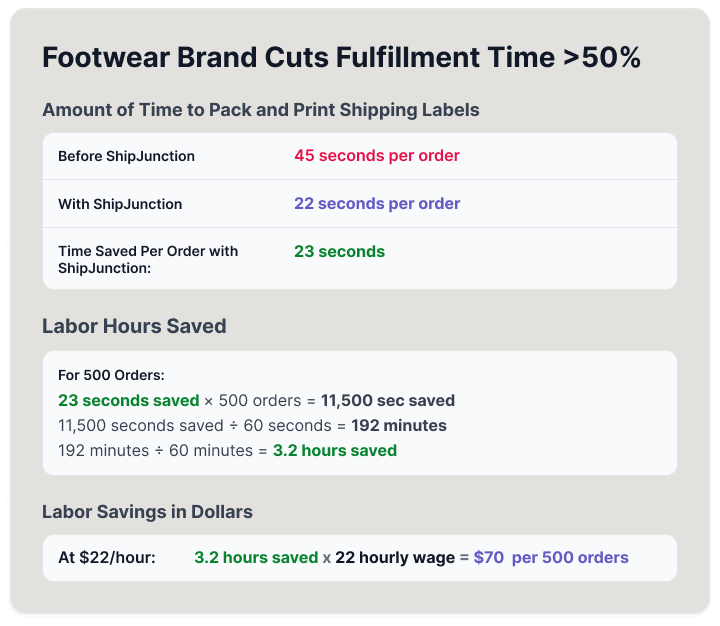
Customer Success Story: How a Safety Footwear Brand Reduces Time to Pick Pack and Ship EDI Orders by Over 50%
One footwear manufacturer saw room for improvement in their EDI fulfillment and turned this into a measurable win. Their operators were spending 45–60 seconds on every order because documents had to be handled separately. ShipJunction consolidated everything into a single workflow improving that time to 15–30 seconds. It may not sound like a lot; however, across hundreds of daily shipments, they now save $70 in labor per every 500 orders fulfilled.
#5 – Automating Address Validation Early for the Win
Validate addresses before fulfillment saves time and eliminates address correction fees.
One industrial supplier learned this the hard way: there was a lot of time and effort dedicated to hand-typing shipment details and fixing mistakes at the end of the day. Now, they use ShipJunction to validate addresses before the pick stage so issues can be flagged upstream and resolved by the customer service team and not the operations team.
As a result, address correction surcharges were eliminated, returns dropped, labor wasn’t wasted on preventable fixes, and the shipping team finally had the breathing room to focus on picking, packing and shipping orders that have valid addresses.
#6 – Handle Specialized Shipping Requirements as Easily as Other Orders
From GS1 carton labels to lithium-ion battery restrictions, compliance shouldn’t be something operators wrestle with order by order. If the system doesn’t automate it, we know the risks. EDI mistakes lead to chargebacks and de-prioritization. For hazardous materials, carriers can refuse the shipment outright, and regulators can impose hefty fines.
Shipping with EDI Compliance Automation
When you’re selling through major retailers, shipping is rarely simple. Every order arrives with its own playbook of rules: routing guides, document templates, and label requirements that must be followed precisely.
A growing jewelry and accessories brand discovered that the hardest part of EDI fulfillment wasn’t packing the boxes or building cartons. For them, it was keeping up with each retailer’s unique set of compliance demands: GS1/UCC-128 labels, retailer-branded packing slips, third-party billing, and the Advance Shipping Notice (EDI 856). Their old shipping setup couldn’t keep pace, and they had resorted to a swivel chain integration.
As the CEO explained, “The EDI orders are all manually entered every day… there’s someone who’s actually doing that physically in the morning. Otherwise, the orders don’t flow through automatically.”
Today, ShipJunction handles those requirements automatically in the background. The system generates the labels, trading partner packing slips, and retailer-specific UCC128 labels automatically at the time of shipping.
What used to be a daily ritual of spreadsheets and copy-pasting across different retail and EDI portals has been replaced by a workflow where document and data compliance happens automatically.
HazMat Shipping Compliance
One medical device distributor felt this pain when nearly one in five orders needed manual intervention for things like lot tracking or hazardous material (HazMat) labeling. Once those steps were automated, compliance shifted from a daily fire drill to a reliable process that automatically happened in the background.
Today, ShipJunction automates shipping for them, which includes the necessary compliance paperwork and labels. Shipments now move out the door on time with correct paperwork, managers aren’t stuck double-checking paperwork, and leadership has the peace of mind that every compliance requirement is handled without exception.
Pick, Pack, and Ship without the Clicks
Clicks may seem small, yet they add up quickly: printing that burn hours, judgment calls at the pack station that slow down lines, and compliance tasks that quietly eat into margins.
ShipJunction changes that. By automating the repetitive steps and embedding compliance, carrier selection, and batch fulfillment into one streamlined process, ShipJunction helps warehouses reclaim lost time and keep orders moving without adding headcount. Teams that adopt it don’t just ship faster; they give their staff breathing room, their leadership peace of mind, and their business a fulfillment process that scales with growth instead of holding it back.
If your team is wrestling with these same bottlenecks, or if you’re simply curious about what a faster, cleaner pick-pack-ship process could look like, we’d be glad to walk you through it. Schedule a live demo session with our sales experts today.